Introduction
The adoption of generative artificial intelligence has reached an unprecedented scale. According to the McKinsey Global Survey 2025, 78% of organizations use AI in at least one business function, while 65% regularly employ generative AI [1]. However, one aspect of adoption remains systematically undervalued: the social dimension. Most of the literature focuses on the individual interaction between operator and model, overlooking the fact that the value of an AI tool grows non-linearly when it is adopted by multiple people within the same professional network.
The present article advances a specific thesis: when multiple people in the same organization or professional network use the same prompt management system, the value generated is not additive but multiplicative. This is a phenomenon that the economics literature defines as a network effect, extensively documented in telecommunications and digital platforms, but still underexplored in the context of AI tools.
The article is structured as follows: Section 1 reviews the theoretical foundations of network effects; Section 2 formalizes the concept of the knowledge multiplier; Section 3 analyzes the role of referral programs as network catalysts; Section 4 proposes a mathematical model of compound value; Section 5 presents a concrete implementation of these principles; Section 6 synthesizes the findings.
1. Network Effects: From Telecommunications to AI Tools
1.1 Metcalfe's Law and Its Descendants
The concept of network effects was first formalized by Robert Metcalfe in the 1980s, in the context of Ethernet networks. Metcalfe's Law postulates that the value of a telecommunications network is proportional to the square of the number of its users:
where represents the number of connected nodes. The intuition is that each new user adds value not only for themselves, but for all existing users, since the number of possible connections grows as .
However, this formulation has been subject to critical revision. Briscoe, Odlyzko, and Tilly (2006) demonstrated that quadratic growth overestimates the actual value of most networks, proposing a more conservative model [3]:
This correction reflects the fact that not all connections in a network have equal value: the first connections are the most valuable, while subsequent ones offer diminishing returns. The model captures this dynamic and has proven more consistent with empirical data observed in digital platforms.
1.2 Network Effects in SaaS
The economics of platforms, as analyzed by Cusumano, Gawer, and Yoffie (2019), distinguishes two types of network effects [4]:
-
Direct effects: more users mean more shared content, more available data, more value for each participant. In a prompt management platform, every user who saves and shares a prompt enriches the collective library.
-
Indirect effects: more users generate more best practices, more consolidated patterns, more quality standards. The average competence level of the network increases with the number of participants who contribute and learn.
There is also an important distinction between inherent and emergent network effects. A tool like Slack has inherent effects: its utility structurally requires the presence of other users. A prompt management system, by contrast, is perfectly usable by a single individual -- but becomes significantly more valuable when colleagues adopt the same tool, generating emergent effects.
1.3 The AI Tool Specificity
AI-based productivity tools occupy a unique position in the landscape of network effects. Unlike a code library or a standard operating procedure manual, a shared prompt is:
- Immediately actionable: it can be copied and used without any integration or configuration.
- Domain-transferable: an effective prompt for data analysis can be adapted in minutes for a different domain.
- Iteratively improvable: every user who employs a shared prompt potentially contributes to its refinement.
According to a study conducted by Panopto, 42% of institutional knowledge is unique to the individual and is not shared with colleagues [5]. In the context of prompts, this percentage may be even higher: prompts are typically personal artifacts, stored in individual chat histories, rarely documented systematically. Every unshared prompt represents blocked potential value.
2. The Knowledge Multiplier Effect
2.1 Individual vs. Collective Competence
The McKinsey Global Survey 2025 reports a significant finding: although 90% of employees have access to generative AI, only 21% qualify as "heavy users" [1]. This asymmetry implies that 79% of users employ AI superficially, achieving results below potential.
Research published in Science by Dell'Acqua et al. (2023) provides a complementary perspective: access to AI increases average productivity by 14%, but with significant variance [2]. Lower-performing workers improve by 43%, while already-competent workers see marginal gains. The finding is crucial: the improvement potential is greatest precisely for those who currently use AI least effectively.
If the knowledge of the 21% of heavy users could be systematically transferred to the 79% of casual users, the aggregate gain would be substantial. A prompt management system that enables structured sharing represents the concrete mechanism for this transfer.
2.2 Formalizing the Multiplier
We define the Knowledge Multiplier as the ratio between the value generated by sharing and the value of individual use:
where is the quality of the prompt used by user , is the usage frequency, is the quality of the best available prompt, and is the expert's usage frequency.
Under the assumption of homogeneous sharing -- that is, all users have access to the best available prompt -- the formula simplifies to:
For a team of 10 people where the average usage frequency matches the expert's, : the value of the best prompt is multiplied tenfold.
| Team size | (homogeneous sharing) | Relative value |
|---|---|---|
| 1 (individual) | 1.0 | Baseline |
| 3 | 3.0 | 3× |
| 5 | 5.0 | 5× |
| 10 | 10.0 | 10× |
| 20 | 20.0 | 20× |
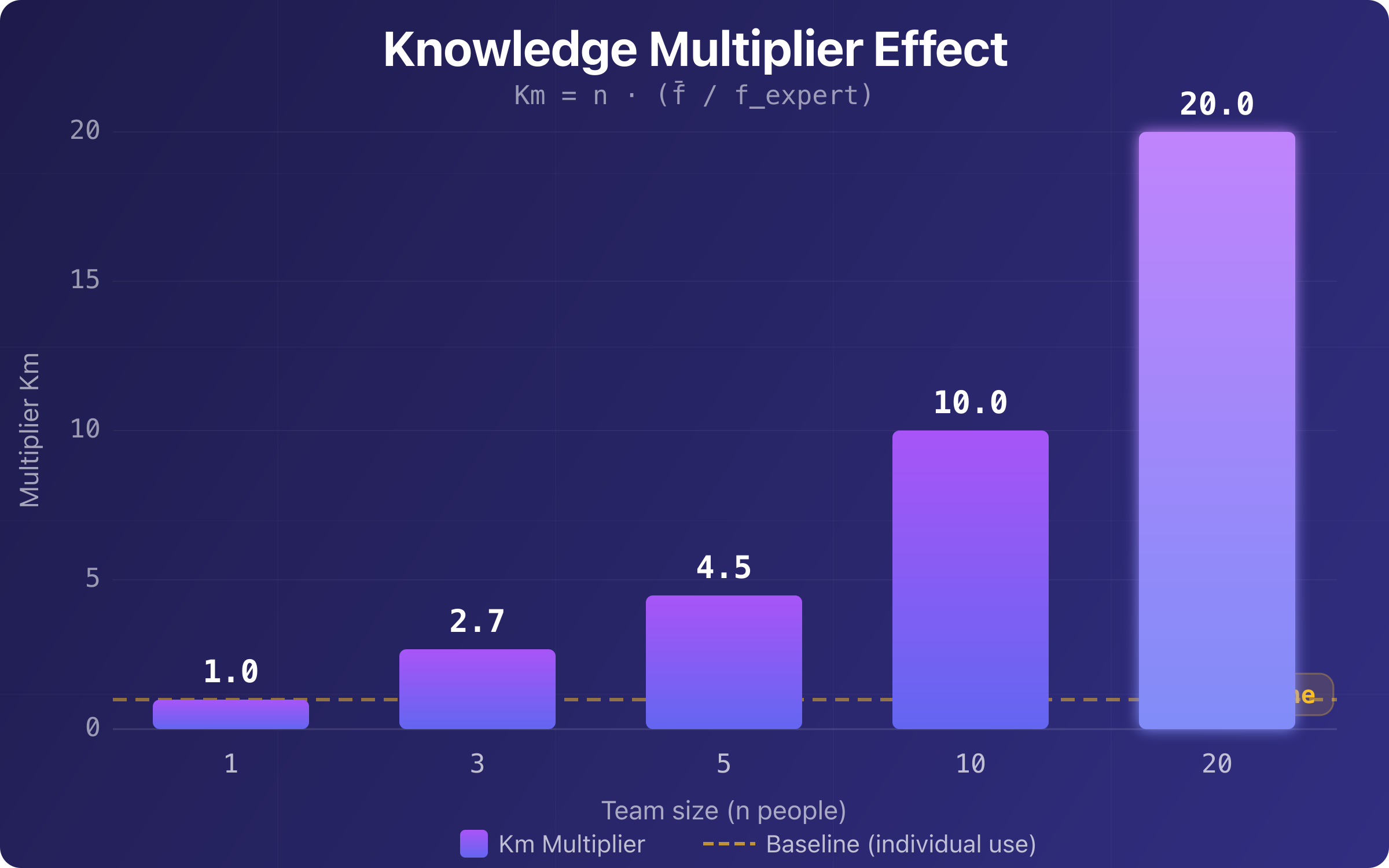
Figure 1. The value of a shared prompt grows linearly with the number of users in the network. Moving from individual use to sharing with just 3 colleagues triples the generated value.
2.3 Empirical Evidence
The literature on organizational learning supports this formalization. Argote and Ingram (2000) demonstrated that knowledge transfer between individuals and organizational units represents one of the most significant sources of competitive advantage for firms [6]. The key mechanism is not the mere availability of information, but the ease with which it can be transferred and applied -- precisely what a prompt management system optimizes.
SQ Magazine reports that organizations adopting standardized prompt libraries achieve 3.2 times more consistent outputs compared to those that do not, with a first-attempt success rate increasing from 34% to 87% [7]. The finding suggests that standardization is not an organizational luxury but a concrete productivity lever.
3. Referral Programs as Network Catalysts
3.1 The Economics of Referral Marketing
Referral programs are traditionally analyzed as customer acquisition tools. However, for knowledge tools, referrals serve a deeper function: they are network catalysts. Every new user acquired through a referral not only expands the user base but potentially enriches the shared knowledge ecosystem.
The study conducted at the Wharton School by Schmitt, Skiera, and Van den Bulte (2011) demonstrated that customers acquired through referrals have a lifetime value (LTV) 16-25% higher than customers acquired through traditional channels [8]. The finding is not accidental: referrals act as a quality filter. Someone recommended by a colleague is more likely to engage in serious, sustained use of the tool, since the recommendation carries with it an expectation of concrete value.
The Nielsen Global Trust in Advertising Survey confirms this dynamic: 92% of consumers report trusting recommendations from people they know, a level of trust unattainable by any other communication channel [9].
3.2 The Dual Benefit of Knowledge Tool Referrals
For knowledge management tools, referrals generate a dual benefit compared to traditional consumer products:
- Acquisition benefit: the standard customer acquisition benefit -- a new user enters the system.
- Network benefit: the new user expands the network of people with whom it is possible to share prompts, techniques, and workflows. The referrer gains not just a reward, but a new node in their knowledge network.
This duality is particularly relevant when the referral occurs within the same professional context. A marketer who invites a colleague is not simply "promoting a product" -- they are creating the conditions for bidirectional sharing of domain-specific prompts.
3.3 The Alignment Principle
Berman (2016) analyzed the conditions under which referral programs generate genuine value rather than opportunistic behavior [10]. The primary conclusion is that incentive alignment is determinative: when the referrer's reward is proportional to the real value generated by the referee's entry, the program produces a virtuous cycle.
A well-designed referral for an AI tool should:
- Require a meaningful action from the referee (not merely registration)
- Reward the referrer with access to advanced features (not just monetary discounts)
- Limit volume to privilege connection quality over quantity
4. Modeling Compound Value in AI Tool Networks
4.1 The Compound Value Model
We propose a model that captures the growth of a prompt library's value over time, as a function of both individual iteration and network size. We define:
where is the initial value of the prompt library, is the monthly improvement rate (through iteration and optimization), is the number of months, and is the number of active users in the network. The logarithmic scaling on reflects the Briscoe-Odlyzko-Tilly correction.
The following table illustrates the divergence over time:
| Months | Individual user () | Network of 5 () | Network of 10 () |
|---|---|---|---|
| 0 | |||
| 3 | |||
| 6 | |||
| 12 |
Assumption: (5% monthly improvement rate).
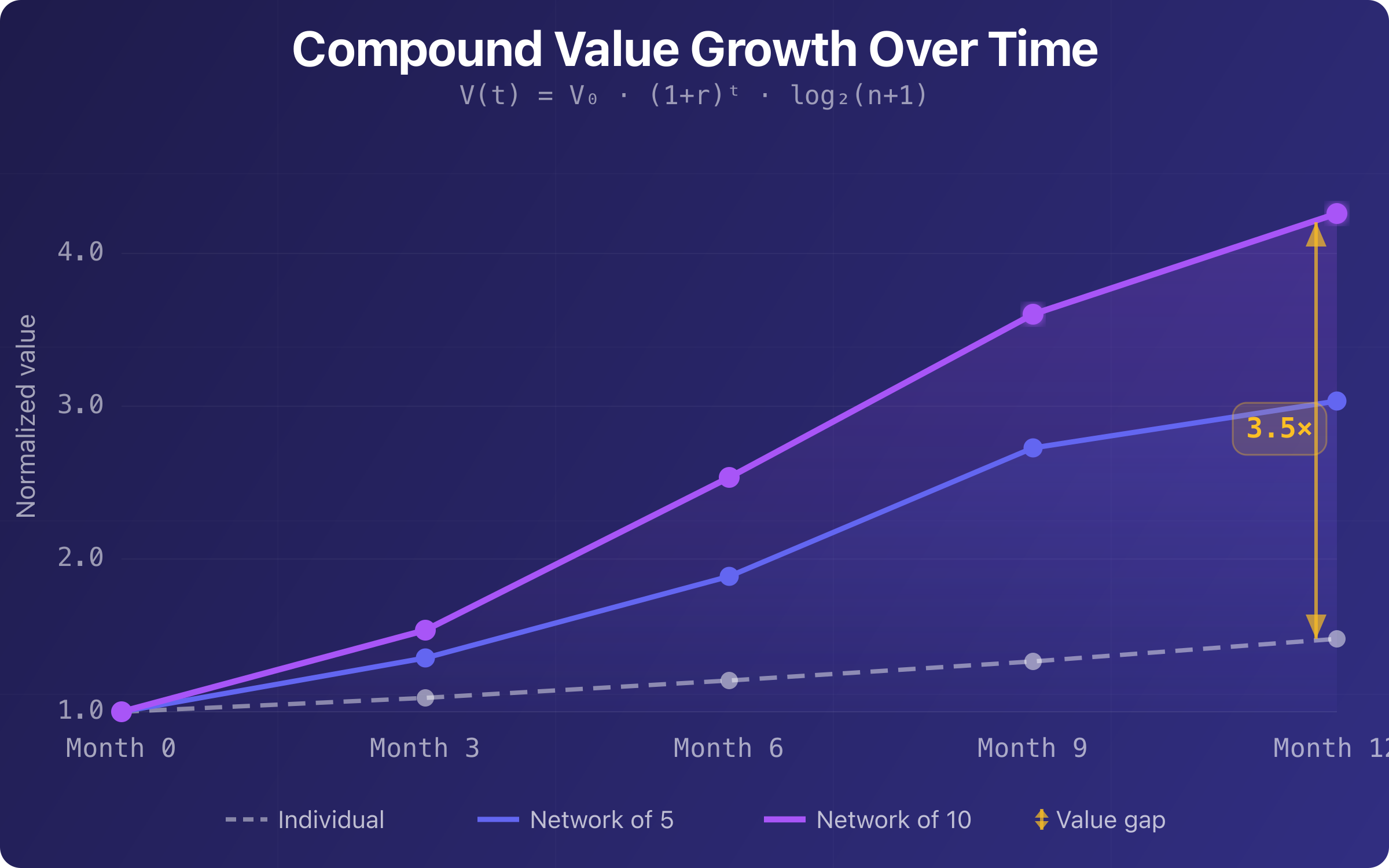
Figure 2. The divergence between individual user and a network of 10 amplifies over time. After 12 months, the network generates 3.5 times the value of the individual user, and the gap continues to widen.
4.2 Time-to-Value Acceleration
An often-overlooked aspect is the network's impact on the time required for a new user to reach full productivity. A user joining a network with an established prompt library starts from a non-zero baseline, unlike an isolated user who starts from scratch.
We formalize this dynamic as:
where is the time required for an isolated user to reach productive use and is the number of users who have already contributed to the shared library.
For a new user joining a network of 9 existing colleagues:
The time to reach full productivity is reduced to one-third. As documented in the previous article in this series [11], the cost of redundant prompt reconstruction can reach 13 hours per year per operator. The elimination of this cost for new network members represents an immediate and measurable saving.
4.3 Practical Implications
The synthesis of the models presented supports three operational conclusions:
-
Sharing generates compound value: the value of an AI tool grows non-linearly with time and network size. Delaying sharing is equivalent to forfeiting compound value.
-
Early adoption amplifies benefits: since the model is multiplicative, every month of delay in network expansion reduces long-term accumulated value.
-
Structured mechanisms outperform organic growth: a referral program that incentivizes targeted colleague invitations accelerates network formation compared to spontaneous diffusion.
5. From Theory to Practice: A Structured Referral Framework
5.1 Design Principles for AI Tool Referrals
Based on the theoretical analysis conducted, an effective referral program for an AI tool should satisfy four principles:
- Low friction: the invitation and registration process must be rapid and intuitive, for both the referrer and the referee.
- Functional reward: the reward should expand access to the tool's most advanced features, strengthening the bond between the referrer and the platform.
- Adoption validation: referral confirmation should not be based on mere registration, but on an action that demonstrates actual tool usage.
- Quality limits: the number of rewarded referrals should be capped to privilege connection quality over quantity.
5.2 A Concrete Implementation: The Keep My Prompts Referral Program
The Keep My Prompts platform has implemented a referral program that translates the above principles into practice. The mechanism works as follows:
- Sharing: the user can share their personalized referral link or send a direct email invitation from Settings → Referral.
- Registration: the referee signs up through the received link (email or direct link).
- Validation: the referral is validated when the referee creates their first prompt within 14 days of registration. This condition ensures that the new user has genuinely begun using the platform.
- Reward:
- If the referee registers with a free plan: the referrer receives +15 days of Pro plan.
- If the referee subscribes to a paid plan: the referrer receives +1 month of Pro plan.
- Monthly cap: maximum 3 rewarded referrals per calendar month, ensuring quality.
| Referee's action | Referrer's reward | Condition |
|---|---|---|
| Free registration + first prompt | +15 days Pro | Within 14 days of registration |
| Paid plan subscription | +1 month Pro | Purchase via Stripe |
| Subsequent upgrade (free to paid) | +15 additional days Pro | Difference applied automatically |
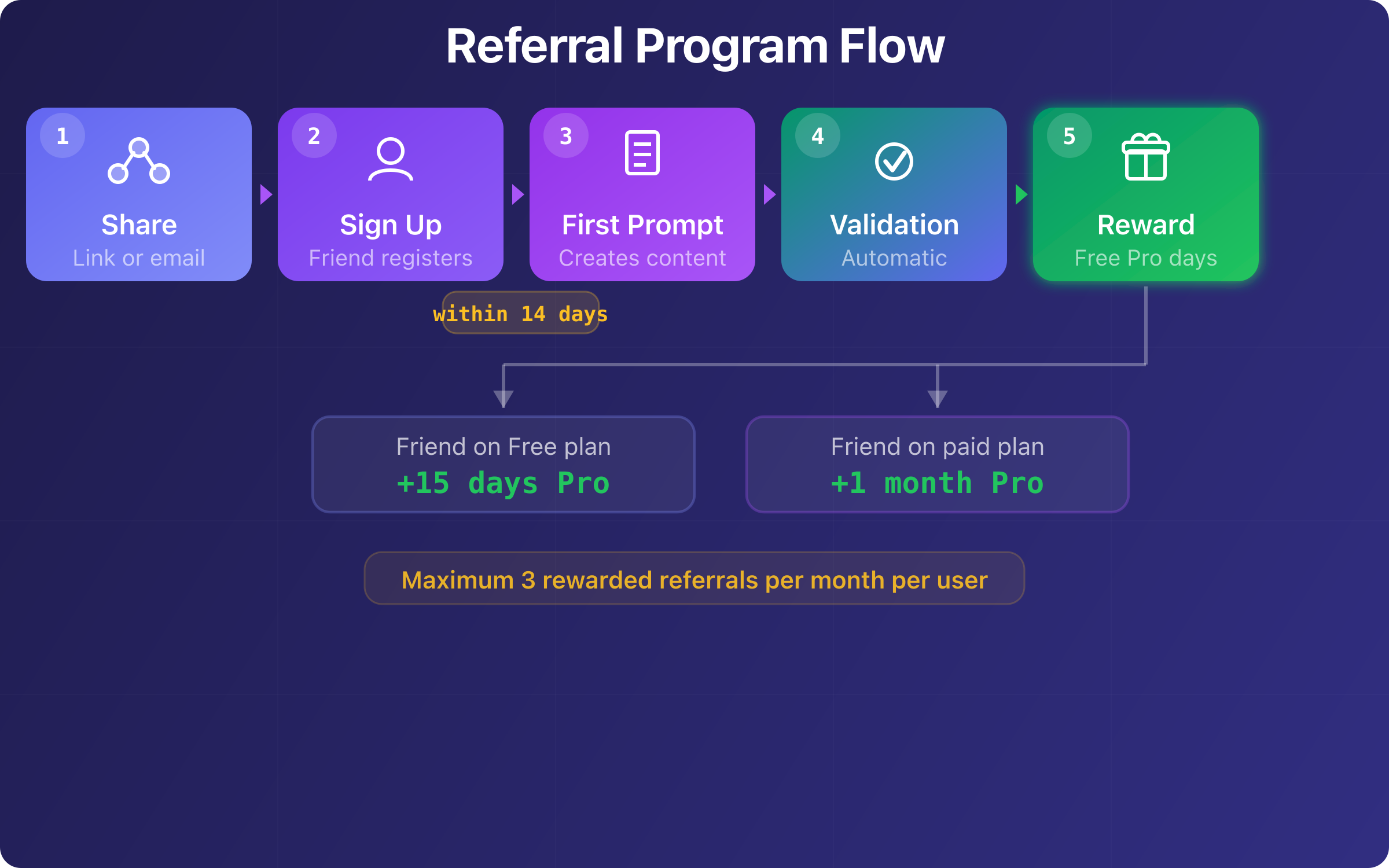
Figure 3. The referral program flow from sharing to reward. Validation requires creating at least one prompt, ensuring genuine adoption.
The Pro plan includes advanced features that amplify network value: version history, public prompt sharing, Prompt Score (AI-powered quality analysis), and Promptimizer Agent (automated prompt optimization). Receiving Pro days as a reward is not merely an individual benefit -- it is an expansion of one's capabilities to contribute to the network.
5.3 Maximizing Network Value
Based on the Knowledge Multiplier model (), it is possible to identify three categories of highest-impact invitations:
-
Colleagues working on the same tasks: thematic overlap maximizes reciprocal prompt reuse. A marketing team sharing prompts for social content creation generates a higher than untargeted invitations.
-
Casual AI users: as documented by Dell'Acqua et al. [2], lower-performing workers derive the greatest benefit from access to optimized prompts. Inviting the colleague who "uses ChatGPT occasionally" has a proportionally greater impact than inviting the expert.
-
Professionals in your domain: domain-specific prompts have the highest value and are the most difficult to reconstruct. A network of professionals in the same sector generates a specialized library whose value exceeds the sum of its parts.
6. Operational Summary
The following table synthesizes the key concepts, associated metrics, and practical implications that emerged from the analysis:
| Concept | Metric | Implication |
|---|---|---|
| Knowledge Multiplier | for a 10-person team | Shared prompts generate 10× the value of individual use |
| Referral customer quality | LTV +16-25% (Wharton) | Referred users are more engaged and generate more value |
| Network value growth | Each new user increases value for all existing users | |
| Time-to-value | New users reach productivity faster in established networks | |
| Standardization impact | 3.2× more consistent outputs | Shared prompt libraries reduce output quality variance |
Conclusion
The evidence from network economics, organizational learning, and referral marketing research converges on a single finding: AI tools become substantially more valuable when used within a network rather than in isolation. The value is not merely additive but compound -- it grows with time, with network size, and with the quality of shared knowledge.
The Knowledge Multiplier formalizes this intuition: a high-quality prompt shared with 10 colleagues generates 10 times the value of its individual use. The compound value model shows that this divergence amplifies over time, making every month of delay in network expansion a growing opportunity cost.
In this context, recommending an AI tool to a colleague is not a promotional act but an investment in a shared knowledge infrastructure whose returns accrue to all participants. The question is not whether to share, but how soon.
References
[1] McKinsey & Company, "The State of AI: How Organizations Are Rewiring to Capture Value," McKinsey Global Survey, 2025. Available: https://www.mckinsey.com/capabilities/quantumblack/our-insights/the-state-of-ai
[2] F. Dell'Acqua et al., "Navigating the Jagged Technological Frontier: Field Experimental Evidence of the Effects of AI on Knowledge Worker Productivity and Quality," Science, vol. 381, 2023. DOI: 10.1126/science.adh2586
[3] B. Briscoe, A. Odlyzko, B. Tilly, "Metcalfe's Law is Wrong: Communication Networks Increase in Value as They Add Members -- But by How Much?" IEEE Spectrum, vol. 43, no. 7, pp. 34-39, 2006. DOI: 10.1109/MSPEC.2006.1653003
[4] M. Cusumano, A. Gawer, D. Yoffie, The Business of Platforms: Strategy in the Age of Digital Competition, Innovation, and Power, HarperBusiness, 2019.
[5] Panopto, "Workplace Knowledge and Productivity Report," 2018. Available: https://www.panopto.com/blog/new-study-workplace-knowledge-productivity/
[6] L. Argote, P. Ingram, "Knowledge Transfer: A Basis for Competitive Advantage in Firms," Organizational Behavior and Human Decision Processes, vol. 82, no. 1, pp. 150-169, 2000. DOI: 10.1006/obhd.2000.2893
[7] SQ Magazine, "Prompt Engineering Statistics," 2025. Available: https://sqmagazine.co.uk/prompt-engineering-statistics/
[8] P. Schmitt, B. Skiera, C. Van den Bulte, "Referral Programs and Customer Value," Journal of Marketing, vol. 75, no. 1, pp. 46-59, 2011. DOI: 10.1509/jmkg.75.1.46
[9] Nielsen, "Global Trust in Advertising Survey," 2021. Available: https://www.nielsen.com/insights/2021/global-trust-in-advertising-study/
[10] B. Berman, "Referral Marketing: Harnessing the Power of Your Customers," Business Horizons, vol. 59, no. 1, pp. 19-28, 2016. DOI: 10.1016/j.bushor.2015.08.003
[11] S. Petrucci, "5 Signs Your Team Needs a Prompt Management System," Keep My Prompts Blog, 2025. Available: https://www.keepmyprompts.com/blog/en/5-signs-you-need-a-prompt-management-system